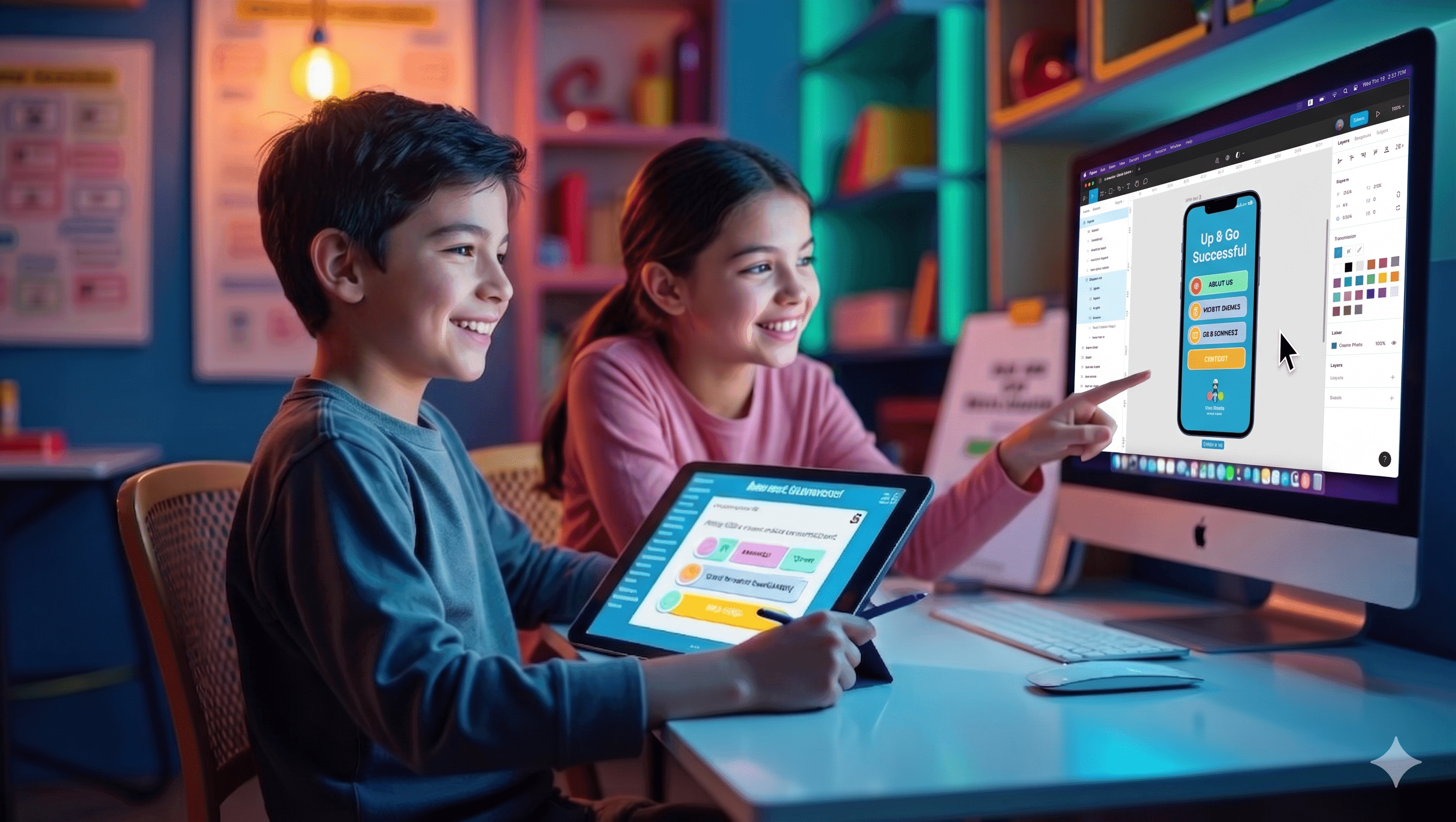
Create Your First Mobile App
Live classes with friendly coaches
Age Group
8–14
Level
Beginner
Duration
12 weeks
Lessons
22 lessons
Course Description
From idea to app—your child builds real technology! In this hands-on course, students explore how mobile apps are created step by step. They learn to design user-friendly interfaces, understand UI/UX, and build layouts using wireframes. Students discover mobile hardware, media tools, and online safety, then apply logic through variables and data. The course ends with building a real Health Tracker App and a final project.
Skills You'll Gain
Frequently Asked Questions
More in this stage
Courses at the same point in the learning journey.
Advanced Programming
As students progress into the complexities of variables, sequences, and loops, they move toward the goal of "analytical application." This course focuses heavily on decomposition—the ability to break down a daunting, multi-layered project into small, manageable components. British academic research shows that this structural approach to programming significantly boosts a child’s general academic independence, as they learn to simulate real-world systems through code. By the end of Level 2, students are no longer just following tutorials; they are designing original digital architectures with efficiency and precision.
8–14 · 22 lessonsPython for Kids
From first lines of code to real creative projects! In this engaging Python course, students start with the basics of programming such as calculations, variables, and text handling. They gradually build strong logical thinking by working with lists, data structures, conditions, and loops. Students then explore creativity through drawing with Turtle graphics, learn how to organize code using functions, and discover how real programs are built using objects and reusable logic. By the end, they confidently create interactive and structured programs using core Python skills.
8–13 · 22 lessonsAI Engineering Foundation
In this introductory building stage, students shift from coding with fixed rules to training models with data. They learn the core mechanics of Machine Learning by building their own image, text, and sound recognition systems. Based on the British "Experience AI" framework, this level focuses on the "Data-Model-Action" loop, ensuring students understand how to curate datasets and identify the impact of bias in AI design. By the end, they aren't just consumers of AI; they are builders who understand the architecture behind intelligent reactions to human input.
9–14 · 22 lessons